Cleanroom Classifications: ISO-14644-1 FED STD 209E and CGMP
Understand cleanroom classifications, particle limits, ISO standards, equivalent Fed Std 209E equivalents, and CGMP grades. Learn which cleanroom classification is appropriate for pharmaceutical, medical device, semiconductor, aerospace and other controlled environment applications.
ISO Class
Equivalent Fed Std 209E Class
Cleanliness
Common Applications
ISO 4
10
No particles
Semiconductor, Nanotechnology
ISO 5
100
Incredibly clean
Pharmaceutical filling, Semiconductor, sterile pharmaceutical, class 3 implantable medical device, satellite assembly
ISO 6
1,000
Extremely clean
Optics, ceramics, pharmaceutical, medical device, semiconductor, biotech
ISO 7
10,000
Very clean
Printed circuit boards, USP800, SB503B pharmacy, aerospace composites, and medical device
ISO 8
100,000
Controlled clean
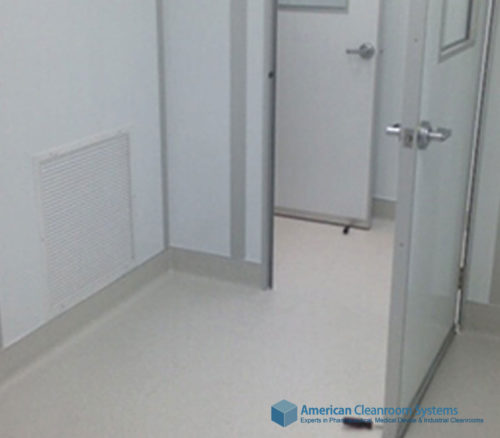
Precision manufacturing, plastic injection molding for medical device, nutraceuticals, gown rooms, aerospace assembly, 3D printing, food processing, mask manufacturing, cleanroom hallways, cleanroom material transfer rooms
Table 1. ISO cleanroom class, Fed Std 209E class and common applications
Cleanrooms are classified by the numbers of particles in a given volume of air. Design requirement for the cleanroom classifications include air changes per hour of HEPA filtered air, HEPA vs ULPA filters, cleanroom ceiling types, cleanroom ISO-8m lighting types, cleanroom flooring types, and air return quantity and locations. People often refer to GMP and CGMP cleanrooms. This refers to cleanrooms designed to meet FDA approved Current Good Manufacturing Practice and are not specific to a certain cleanroom classification. Other cleanroom standards include EU GMP annex, BS 5295, SB503B and USP797/800. American Cleanroom Systems has experience building ISO-4 thru ISO-8, class 10 thru class 100,000, and EU GMP Annex A thru D cleanrooms.
ISO 14644-1 Cleanroom Standards | Cleanroom Classifications
Table 2. ISO 14644-1 allowed particles per cubic meter
Which cleanroom class do I need?
ISO-5 cleanroom class is commonly used for semiconductor manufacturing, pharmaceutical filling, nano technology, and implantable medical devices cleanrooms.
ISO-6 cleanroom class is used for less critical semiconductor manufacturing steps, optics, and medical device, and pharmaceutical manufacturing,
ISO-7 cleanroom class is commonly used for printed circuit board manufacturing, USP800 compounding, and aerospace composite manufacturing , and medical device manufacturing cleanrooms.
ISO-8 cleanroom class is commonly used for precision industrial manufacturing, plastic injection molding for medical devices, nutraceuticals, assembly, nutraceuticals, packaging, and food cleanrooms.
Talk to a cleanroom expert now 949-589-5656
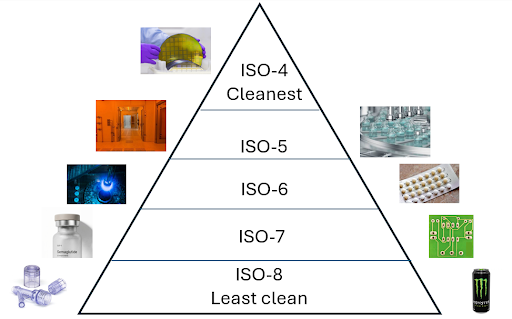
Figure 1. Cleanroom Classification Pyramid
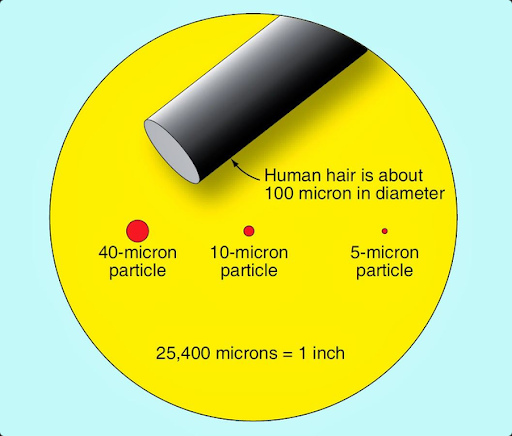
Figure 2. Human hair in microns (image courtesy of US Navy)
What is difference between ISO cleanroom class and FED Std 209E cleanroom class?
The ISO 146444-1 standard counts the number of particles per cubic meter. The older FED STD 209E standard counts the number of particles per cubic foot. The semiconductor, electronics industry, and aerospace industry still use FED STD 209E to describe cleanrooms. The FED Std 209E classifications are easier to understand as they tie directly to the numbers of particles per cubic foot.
US FED STD 209E Cleanroom Standards & ISO Equivalents
Class
Maximum Particles/ft³
ISO Equivalent
>0.1 µm
>0.2 µm
>0.3 µm
>0.5 µm
>5 µm
1
35
7
3
1
ISO 3
10
350
75
30
10
ISO 4
100
100
ISO 5
1,000
1,000
7
ISO 6
10,000
10,000
70
ISO 7
100,000
100,000
700
ISO 8
Table 3. FED STD 209E allowed particles per cubic foot (use existing html table)
What does an ISO5, ISO7 or ISO8 cleanroom require?
ISO 5:
Minimum 70% ceiling coverage with ULPA/HEPA filters in ceiling
300-500 air changes per hour
Raised floor air returns or low wall air returns on long axis
Aluminum or FRP cleanroom walls
Temperature and humidity control
ISO-7
60 air changes per hour HEPA fan filter units in ceiling
Low wall air returns
Gown room / air locks
Heat welded vinyl or epoxy flooring
ISO-8
20 air changes per hour HEPA fan filter units in ceiling
Cleanable cleanroom walls
Positive pressure
VCT or sealed concrete flooring
Design Requirements for Cleanroom Classifications
Criteria
Class 10 ISO4
Class 100 ISO5
Class 1000 ISO6
Class 10,000 ISO7
Class 100,000 ISO8
Air changes per HR/Min
500-600 / 8 to 10
300 to 480 / 5 to 8
180 / 3
60 /1
20 /0.33
Filter coverage %
90 – 100
60 – 70
20 – 30
7 – 15
4 – 5
CFM per square foot
85 – 90
36 – 65
18 – 32
9 – 16
4 – 8
Filter Efficiency
99.9997% ULPAs
99.997% HEPAs
99.997% HEPAs
99.997% HEPAs
99.97% HEPAs
Ceiling Type
Aluminum T-bar grid
Aluminum T-bar grid
Aluminum T-bar grid
Conventional T-bar grid
Conventional T-bar grid
Light Fixture type
Tear drop or Flow thru
Tear drop or 2’x4’ cleanroom fixture
2’x4’ cleanroom fixture
2’x4’ cleanroom fixture
2’x4’ standard fixture
Ceiling Panel
FRP, Vinyl rock or Mylar
FRP, Vinyl rock or Mylar
Vinyl rock or Mylar
>Vinyl rock or Mylar
Vinyl rock or Mylar
Wall System
Modular or standard built
Modular or standard built
Modular or standard built
Modular or drywall
Modular or drywall
Flooring cover
Welded sheet vinyl or Epoxy
Welded sheet vinyl or Epoxy
Welded Sheet vinyl or Epoxy
Sheet vinyl or VCT
Sheet vinyl or VCT
Flooring base
2” to 6” cove
Cove or Aluminum base channel
Cove or Aluminum base channel
Cove or Aluminum base channel
Cove or Aluminum base channel
Air Returns
Raised floor or center returns
Low wall on long axis
Low wall at perimeter
Low wall
Low wall or ceiling
Table 4. Design Requirements for cleanroom class ISO5 thru ISO8
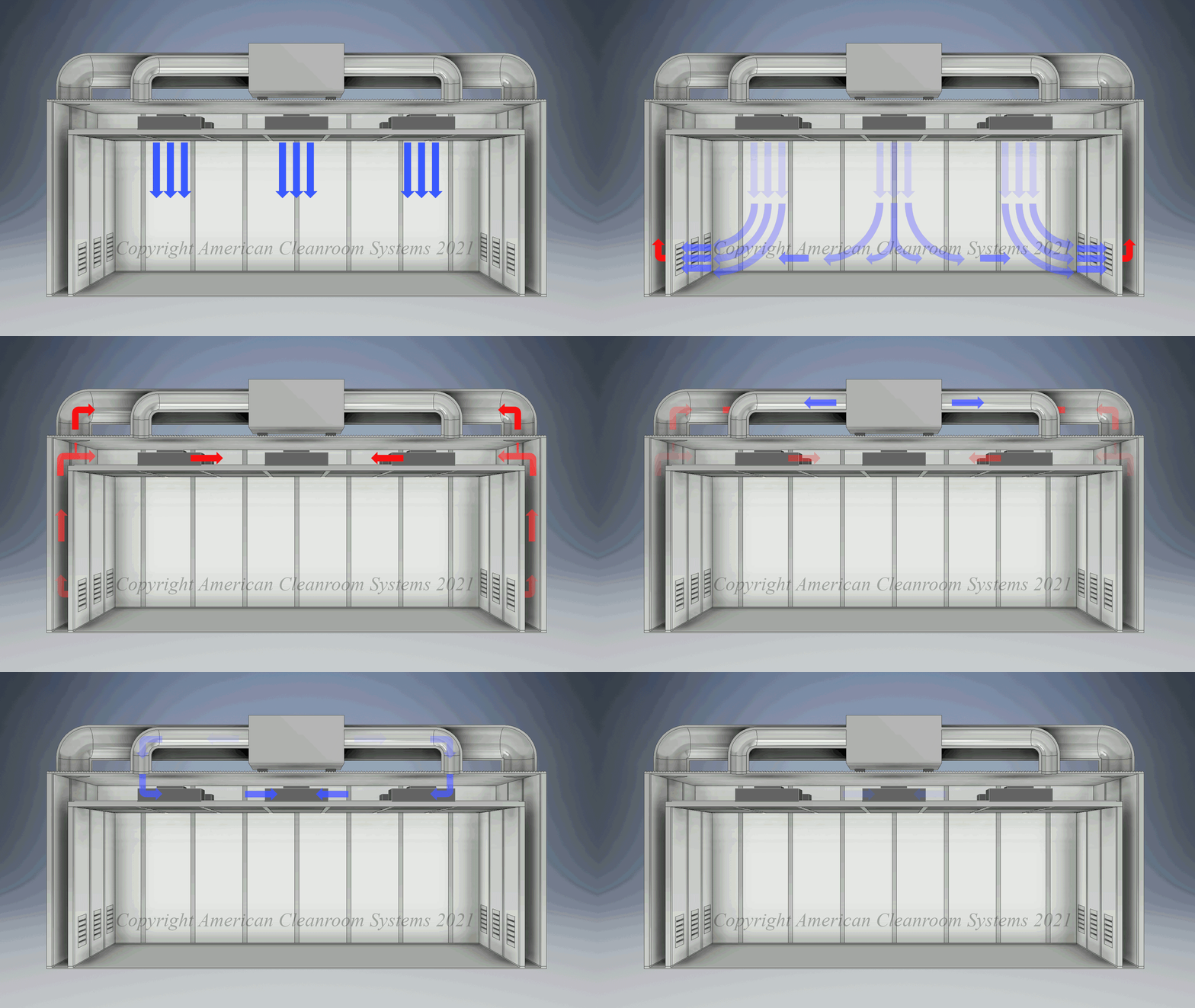
Figure 3. How cleanroom air flow works in a recirculating cleanroom
Other cleanroom classification systems include European GMP Annex
GMP Annex European Community Cleanroom Standards
Grade
At Rest >0.5 um/M³
At Rest >5um/M³
Operational >0.5um/M³
Operational >0.5um/M³
Equivalent ISO at rest/operational
Equivalent Fed209E at rest / operational
A
3,520
20
3,520
20
ISO-5/5
100/100
B
3,520
29
352,000
2,900
ISO-5/7
100/10k
C
352,000
2,900
3,520,000
29,000
ISO-7/8
10k/100k
D
3,520,000
29,000
not defined
not defined
ISO-8/na
100k/na
Table 5. GMP Annex cleanroom classes
What is difference between cleanroom classification and cleanroom certification?
Cleanroom classification determines the level of airborne particles cleanliness.
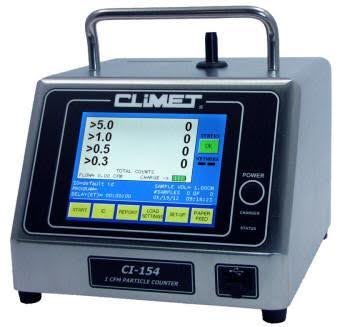
Cleanroom certification or cleanroom testing verifies the cleanroom meets the designed cleanroom class. Testing is done with particle counters. Differential air pressure is also measured. In some cases, HEPA fan filter unit air flow volume is also measured.
Cleanroom Air Flow – Recirculating Modular Cleanroom
Types of Cleanrooms:
Modular Cleanroom
Modular Cleanroom
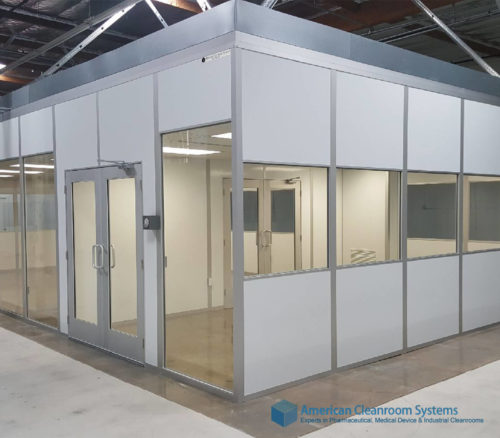
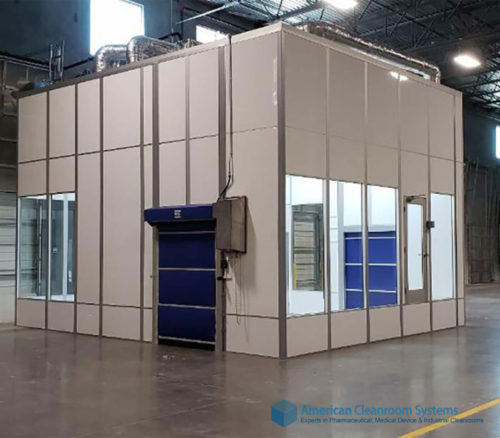
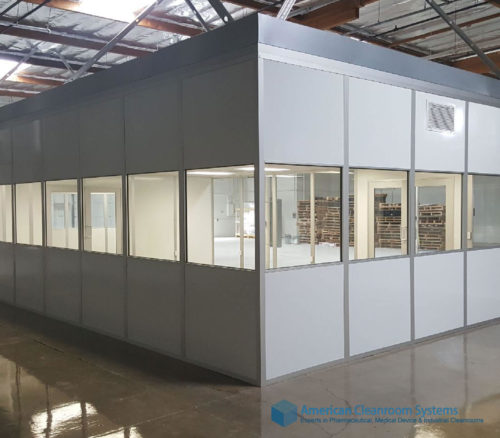
A Modular Cleanroom is a cleanroom built using prefabricated modular components then assembled on-site. Why choose modular cleanrooms?
Modular cleanrooms can be manufactured and installed 50% faster than stick built conventional construction cleanrooms.
Unlike conventional construction cleanrooms, modular cleanrooms are easily modified, expanded, or relocated.
Modular cleanrooms can be built for any classification (class 100-100k, ISO5-ISO8) with temperature and RH control.
Hybrid Cleanroom
Hybrid Cleanroom
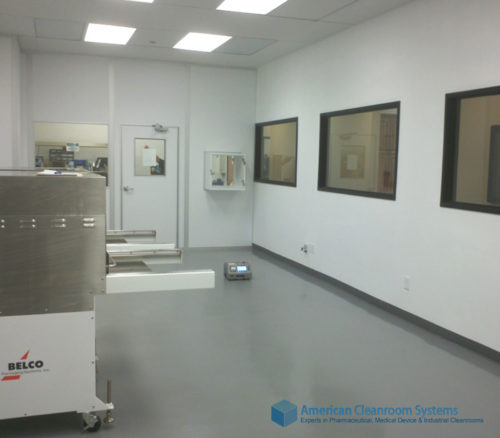
A Hybrid Cleanroom is a cleanroom built combining modular components with existing conventional construction walls. When to use a hybrid cleanroom design?
Combine modular cleanroom air returns and internal walls with existing conventional construction walls can offer cost savings.
The use of modular cleanroom components significantly speeds up installation of cleanroom.
Hybrid works best for less demanding ISO-7 or ISO-8 class cleanrooms.
Softwall Cleanroom
Softwall Cleanroom
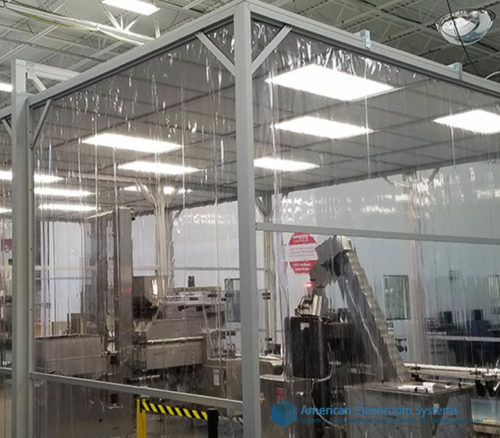
A Softwall Cleanroom is a cleanroom created by hanging clear vinyl curtains on an aluminum frame to create walls.
Softwall cleanrooms are one pass. Filtered air is pulled by HEPA fan filter units into the cleanroom. The air passes under the curtain back into the surrounding room.
Softwall cleanrooms can be mounted on casters so they can be easily relocated.
Unlike recirculating modular cleanrooms, you cannot add air conditioning to softwall cleanrooms.
Pharmaceutical cleanrooms are designed to provide a controlled environment as specified by your approved FDA validation and CGMP practice.
The modular cleanroom is optimized to create a sterile manufacturing environment for the pharmaceutical products.
Filling rooms are typically ISO5 class 100.
FRP modular cleanroom walls are standard due to the aggressive chemicals used to clean pharmaceutical cleanrooms.
Turnkey Complete Cleanroom
Turnkey Complete Cleanroom
A Turnkey Complete Cleanroom is when the modular cleanroom company provides beginning to end service, doing all aspects of the cleanroom project. This includes:
Modular cleanroom design
Manufacturing of modular cleanroom material
Installation of modular cleanroom
HVAC, electrical, and flooring provided
Certification of modular cleanroom
Mask Manufacturing Cleanroom
Mask Manufacturing Cleanroom
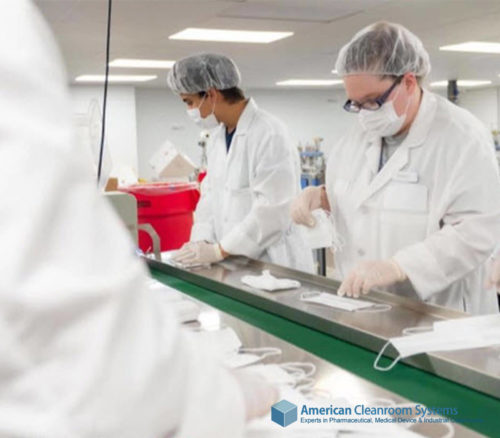
A Mask Manufacturing Cleanroom is a cleanroom that is used for manufacturing of K95 and surgical masks during the Covid-19 crisis.
The cleanroom is designed to provide a sterile controlled environment due to mask classification as medical device
Special modular cleanroom design for rapid manufacturing in factory and installation by customer in field
Using modular cleanroom walls systems allowed existing warehouse to be quickly converted into cleanroom at reasonable price
Laser Cleanroom
Laser Cleanroom
A Laser Cleanroom is a cleanroom optimized for sensitive laser experiments.
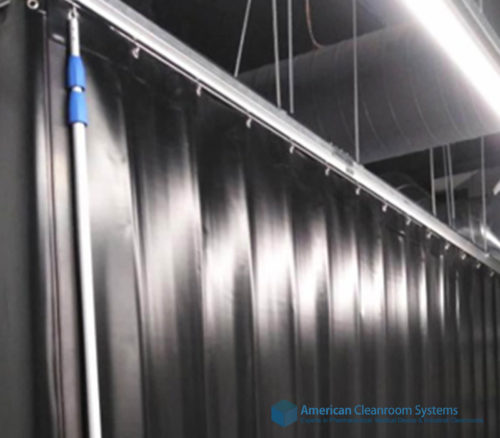
Cleanroom blackout curtains
HEPA filtration to remove air particulates in cleanroom that could influence experiments
Tight temperature and humidity control for the cleanroom space
Static Dissipative Cleanroom
Static Dissipative Cleanroom
A Static Dissipative Cleanroom is designed to prevent static from building up within the cleanroom which can damage sensitive electronic components. Features include:
Static dissipative modular cleanroom walls
Static dissipative cleanroom flooring
Humidity control
Ionizer bars
E-Liquid Cleanroom
E-liquid Cleanroom
An E-liquid Cleanroom is designed for mixing of E-liquids for electronic cigarettes.
E-liquid cleanrooms provide a controlled clean environment for manufacturing of e-liquid ingredients per government regulations
Modular cleanroom features result in quick installation and easy expansion of the e-liquid cleanroom
Modular cleanroom is an economical solution for a smaller size cleanroom used by many e-liquid companies.
ISO7 or ISO8 cleanroom with HEPA fan filter units to filter the air in the cleanroom
Cleanable modular cleanroom walls
Gowning room airlock to don cleanroom garments
Magnehelic gauges to measure air pressure of cleanroom vs. ambient.
Common Cleanroom Standards
Fed209E. US government standard for cleanroom classification issue by the GSA. Measurements are in particles/cubic foot. It was superseded in 2021 by ISO 14644-01 -
FDA GMP or CGMP: FDA standards for Current Good Manufacturing Practices for pharmaceutical, drug, cosmetics, food, nutraceutical and products regulated by the US Food and Drug Administration
BSL1-4 : Bio Safety Level or pathogen protection level is set of biocontainment precautions designed to isolate dangerous biological agents in a contained biological laboratory. Issued by the US Center of Disease Control or CDC.
Viable testing (settling plates and growth cultures). Culture plates and tapes to measure density of live organisms such as bacteria, yeast, mold, fungus, virus, etc.
A: ISO cleanroom classification divides cleanroom into different particle cleanliness levels based on number of particles per cubic meter. The Fed Std 209E classification system uses number of particles per cubic foot.
Q: What Is a Cleanroom?
A: A cleanroom (or clean room) is a room that has HEPA filtration to remove particles from the air. Cleanrooms are used for manufacturing where high levels of cleanliness and sterility are required. Common applications are medical devices, pharmaceutical and semiconductor manufacturing. The FDA mandates the use of cleanrooms to create GMP manufacturing factories.
Q: What Are Cleanrooms Used For?
A: Cleanrooms are used for manufacturing where high levels of cleanliness and sterility are required. Common applications are medical devices, pharmaceutical and semiconductor manufacturing. Cleanrooms use HEPA filters to remove particles from the air. It is common to see pharmaceutical cleanrooms, medical device cleanrooms, semiconductor cleanrooms, electronic cleanrooms, aerospace cleanrooms, food cleanrooms, USP797 compounding pharmacy cleanrooms and biotech cleanrooms. Cleanrooms are also used by the government such as national labs, defense industries, and R&D labs at universities.
Q: How Clean Is a Cleanroom?
A: Very clean. A class 100 cleanroom has 100 particles per cubic foot. By comparison your typical office space has between 500,000 and 1 million particles per cubic foot. Cleanrooms come in different classes from class 100 to 100,000.
Q: When Is a Cleanroom Required?
A: Medical device and pharmaceutical manufacturing requires sterile environments to produce their products. Cleanrooms provide this sterile super clean manufacturing space which reduces the chance of contamination getting in your medicine. Semiconductor manufacturers produce devices with ultra small super dense features. Examples are computer chips for your cell phone or PC. If contamination were to get on the chip during manufacturing, they would not work.
Q: What Does ISO Stand For?
A: ISO is the International Standards Organization. It has created the ISO 4644-1 Cleanroom Standards that describe the allowed number of particles, the allowed size of particles and HEPA filtered air flow changes per hour meet ISO-4, ISO-5, ISO-6, ISO-7, and ISO-8 standard. It relies on measurements per cubic meter. It corresponds to the USA based Fed Standard 209E which relies on measurements per cubic foot. Fed Standard 209E corresponding classes are 10, 100, 1000, 10k and 100k.
Q: What is Clean Room in Pharma?
A: In pharma a clean room is a controlled environment using HEPA filtration to minimize particulate contamination. Pharmaceutical manufacturers are subject to FDA validation of their manufacturing which typically specify use of a clean room to ensure the quality of the manufactured pharmaceutical product. Sterility is highest priority. Pharma cleanrooms focus on both non viable (inanimate) and viable (live) contamination. They typically use laser particle counters to measure non viable contamination levels and settling plates with culture media to measure viable contamination levels. Pharmaceutical cleanrooms use aggressive chemical and UV light cleaning techniques to maintain sterility.
Q: What is a Data Cleanroom?
A: A data cleanroom is a secure isolation virtual platform that typically stores anonymized marketing data from multiple sources. It is used to protect privacy and share data from multiple sources. It is very different from physical cleanrooms used for manufacturing.
Q: How Do Cleanrooms Work?
A: Cleanrooms rely on HEPA or ULPA filtration to remove particles from the air and create an ultra clean environment. With sufficient air changes per hour and laminar air flow it is possible to reduce particulate count from greater then 500k/ft3in typical office space to as low as 100/ft3(class 100 cleanroom). Airlocks are used to prevent contamination from entering the cleanroom. Workers inside cleanrooms typically wear cleanroom garments such as booties and bunny suits to prevent them from bringing contamination into the room. Eating and drinking are never allowed in cleanrooms.
Q: Who Needs a Cleanroom?
A: Industries such as pharmaceutical, medical device and USP797 compounding pharmacies are required by the government to manufacture in sterile environment and must use cleanrooms. Other industries such as semiconductor, electronics, aerospace and optics find the ultra-clean environments in cleanrooms are the only way to cost effectively manufacture their products. Other industries that use cleanrooms include food, beverage, e-liquid, CBD and vitamins.
Q: What is a Pharmaceutical Cleanroom?
A: Pharmaceutical manufacturers are subject to FDA validation of their manufacturing which typically specify use of a clean room to ensure the quality of the manufactured pharmaceutical product. Sterility is highest priority. Pharmaceutical cleanrooms focus on both non viable (inanimate) and viable (live) contamination. They typically use laser particle counters to measure non viable contamination levels and settling plates with culture media to measure viable contamination levels. Pharmaceutical cleanrooms use aggressive chemical and UV light cleaning techniques to maintain sterility.
Q: What is a Class 1 Cleanroom?
A: A class 1 cleanroom refers to ISO standard allowing less than 2 particles greater than 0.3 microns and no particles greater than 1.0 microns per cubic meter. A class 1 cleanroom typically has from 500-750 air changes per hour and typically utilizes ULPA filtration. Other common characteristics are 100% ULPA ceiling coverage and raised floors. It is the cleanest classification.
Q: What is a Class 2 Cleanroom?
A: A class 2 cleanroom refers to ISO standard allowing less than 11 particles greater than 0.3 microns and no particles greater than 1.0 microns per cubic meter. A class 2 cleanroom typically has 500-750 air changes per hour and typically utilizes ULPA filtration. Other common characteristics are 100% ULPA ceiling coverage and raised floors. It is the 2nd most clean classification.
Q: How Many Types of Cleanrooms Are There?
A: The most common type cleanrooms are modular cleanrooms, stick-built cleanrooms (or standard), and softwall cleanrooms. Modular cleanrooms utilize prefabricated modular wall systems which allow for faster installation, easy modification(s) and reasonable cost. Stick built or standard cleanrooms rely on conventional steel stud(s) drywall construction. It can be slightly cheaper. Softwall cleanrooms use clear vinyl curtains suspended from metal frames. Small softwall cleanrooms are often mounted on casters so they can be easily moved around.
Q: What is a Class 4 Cleanroom?
A: A class 4 cleanroom refers to ISO standard allowing less than 1020 particles greater than 0.3 microns and less than 2 particles greater than 5.0 microns per cubic meter. A class 5 cleanroom requires from 500-600 air changes per hour and typically utilizes ULPA filtration. Other common characteristics are 100% ULPA ceiling coverage and raised floors. It is the 4th most clean classification.
Q: How Do You Prepare For Cleanroom / Installations?
A: If you need an ISO-7 cleanroom you should prepare your facility for the modular cleanroom installation. Check that area is free and clear up to height of cleanroom. Frequently existing electrical conduit, lighting, sprinklers, and HVAC ducting need to be relocated. When installing new cleanroom flooring make sure the existing concrete is in good shape. Have any cracks and depressions filled to level the floor.
What Are the Do and Don’ts in a Cleanroom?
Do:
Do wipe down all surfaces on a regular basis to remove contamination.
Do make sure doors are always closed to maintain positive pressure.
Do always have all staff were cleanroom suits over their street clothes to prevent bringing contamination into the cleanroom.
Don't:
Don’t eat or drink in your cleanroom.
Don’t bring dirty equipment or material into cleanroom – always wipe it down before bringing it in.
Don’t turn off the HEPA fan filter units – it will take several hours after you turn them back on before the cleanroom is clean again.
ISO Cleanroom Specifications
The ISO 1 specification for cleanrooms require less than 2 particles greater than 0.3 microns and no particles greater than 1.0 microns per cubic meter. An ISO 1 cleanroom typically has from 500-750 air changes per hour and typically utilizes ULPA filtration. Other common characteristics are 100% ULPA ceiling coverage and raised floors.It is the most clean of the cleanroom classification.
The ISO 2 specification for cleanrooms requires less than 11 particles greater than 0.3 microns and no particles greater than 1.0 microns per cubic meter. A IS0 2 cleanroom typically has 500-750 air changes per hour and typically utilizes ULPA filtration. Other common characteristics are 100% ULPA ceiling coverage and raised floors.It is the 2ndmost clean classification.
The ISO 3 specification for cleanrooms requires less than 102 particles greater than 0.3 microns and no more than 8 particles greater than 1.0 microns per cubic meter. A IS0 3 cleanroom typically has 500-750 air changes per hour and typically utilizes ULPA filtration. Other common characteristics are 100% ULPA ceiling coverage and raised floors.It is the 3rd most clean classification.
The ISO 4 specification for cleanrooms requires less than 1020 particles greater than 0.3 micronsand no more than 2 particles greater than 5.0 microns per cubic meter. An IS0 4 cleanroom typically has 500-600 air changes per hour and typically utilizes ULPA filtration. Other common characteristics are 100% ULPA ceiling coverage and raised floors.It is the 4th most clean classification.
The ISO 5 is a super clean cleanroom classification. A cleanroom must have less than 3,520 particles >0.5 micron per cubic meter and 250-300 HEPA filtered air changes per hour. The equivalent FED standard is class 100 or 100 particles per cubic foot. Common applications are semiconductor manufacturing and pharmaceutical filling rooms.
The ISO 6 is a very clean cleanroom classification. A cleanroom must have less than 35,200 particles >0.5 micron per cubic meter and 180 HEPA filtered air changes per hour. The equivalent FED standard is class 1000 or 1000 particles per cubic foot.
The ISO 7 is a common clean cleanroom classification. A cleanroom must have less than 352,000 particles >0.5 micron per cubic meter and 60HEPA filtered air changes per hour. The equivalent FED standard is class 10.000 or 10,000 particles per cubic foot. Common applications are pharmacy USP800 compounding rooms, electronics manufacturing and medical device manufacturing.
The ISO 8 is the least clean cleanroom classification. A cleanroom must have less than 35, 200,000 particles >0.5 micron per cubic meter and 20 HEPA filtered air changes per hour. By comparison a typical office space would be 5-10 times more dirty. The equivalent FED standard is class 100,000 or 100,000 particles per cubic foot. Common applications include plastic extrusion for medical devices, e-liquid manufacturing, and nutraceutical packaging.
American Cleanroom Systems® 2026 - Unauthorized use and/or duplication of this material without express and written permission from this website owner is strictly prohibited. Excerpts and links may be used, provided that full and clear credit is given to American Cleanrooms with appropriate and specific direction to the original content.


 Spanish