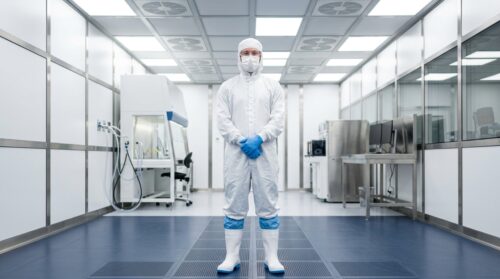
People are the biggest source of contamination in any cleanroom. A person sheds about 40,000 skin cells a minute, and simply walking across a room can throw off more than a million particles a minute. That is why personnel account for an estimated 75 to 80 percent of the particles found in a cleanroom. Gowning is how you keep that contamination off the product. This guide covers the cleanroom gowning procedure in the correct order, how gowning changes by ISO class, how to de-gown on the way out, and the mistakes that quietly wreck a clean space.
What Is Cleanroom Gowning?
Cleanroom gowning is the controlled process of putting on cleanroom garments, in a set order, before entering a controlled environment. The point is to cover the parts of a person that shed particles so those particles never reach the air or the product.
What you wear depends on how clean the room has to be. A less strict room might call for a frock, a hairnet, and gloves. A stricter room needs a full coverall, hood, mask, goggles, boots, and two pairs of gloves. The ISO cleanroom classification sets the bar, and the gowning level is matched to it.
The order matters as much as the garments. Gown in the wrong sequence and you contaminate clean garments with dirty hands, or drag a sleeve across the floor, and the whole point is lost.
Before You Gown: Preparation
Gowning starts before you touch a single garment.
- Remove jewelry, watches, and personal items such as keys and phones.
- Remove makeup and skip perfume or scented lotion.
- Tie back long hair.
- Wash and dry your hands, then sanitize them.
- Step onto the sticky mat at the entrance to pull grit off your shoes.
Most facilities have a pre-gowning area where operators change into dedicated undergarments like scrubs. This keeps street clothes, and the fibers they carry, out of the gowning room entirely.
The Cleanroom Gowning Procedure, Step by Step
The guiding rule is top to bottom, clean to dirty, and never let a garment touch the floor. Work in front of a mirror, and keep your gloved or clean hands off any outer surface you do not need to touch.
Here is a representative gowning order for a full-coverall cleanroom:

- Sanitize your hands and put on the first pair of gloves. Clean hands protect every garment you handle after this.
- Put on shoe covers or booties at the step-over bench. Cover one foot, swing it over to the clean side of the bench, then do the other. The bench keeps clean and non-clean floors apart.
- Put on the hood or bouffant cap. Tuck in all of your hair. Add a beard cover if you have facial hair.
- Put on the face mask and goggles. The mask covers your nose and mouth; the goggles seal against the hood.
- Step into the coverall. Hold it away from the floor, put one leg in at a time, then pull it up and zip it. Pull the collar snug around the hood so no skin or hair is exposed.
- Put on boot covers over the legs of the coverall. The coverall goes inside the boot, not over it, so particles cannot escape at the ankle.
- Put on the second pair of gloves. Pull the cuffs over the sleeves of the coverall so there is no gap at the wrist.
- Sanitize your gloves and check yourself in a full-length mirror. Look for exposed skin, loose hair, or a garment touching the floor before you enter.
The exact order shifts with the room and the standard you follow. Sterile and aseptic areas add steps and use sterile, individually packaged garments. Use this as a starting framework, not a substitute for your facility's validated procedure.
Gowning Requirements by ISO Class
Cleaner rooms need more coverage. The table below is a general guide. For the full requirements at each level, see our guide to cleanroom gowning levels.
| Cleanroom class | Typical gowning |
| ISO 8 | Frock or lab coat, hairnet, gloves, shoe covers |
| ISO 7 | Coveralls, hood, gloves, shoe covers |
| ISO 5–6 | Full coverall (bunny suit), hood, mask, goggles, boots, double gloves |
Sterile pharmaceutical areas, such as Grade A and B zones under EU GMP, go further. They require sterile gowning, more rigorous procedures, and gowning that is validated and monitored for each operator.
De-Gowning (Doffing) Procedure
Coming out matters too. By the end of a shift, the outside of your garments has collected particles, so de-gowning is about not spreading them.
Work in reverse, from the most contaminated item to the least, and peel garments inside out so the dirty surface folds inward. Remove outer gloves first, then boots, coverall, hood, and mask, and sanitize your hands at the end. Reusable garments go into a designated bin for laundering; disposable items go in the trash. Never re-wear a single-use garment.
The Gowning Room
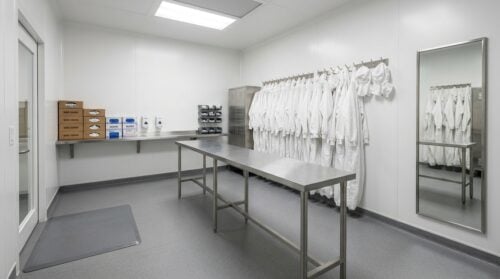
The gowning room is the airlock between the outside world and the cleanroom, and its layout does half the work. A step-over bench splits the room into a non-clean side and a clean side, so an operator physically crosses from dirty to clean while gowning. Sticky mats catch particles at the door. A full-length mirror lets operators check their gowning.
Higher-class cleanrooms add an airlock and often an cabina de aire between the gowning room and the cleanroom, using fast jets of filtered air to blow off any loose particles before entry. When we design a cleanroom, the gowning room and its airflow are part of the plan from the first drawing.
Common Cleanroom Gowning Mistakes
Even experienced operators slip into habits that raise contamination risk. The usual ones:
- Gowning in the wrong order, which lets dirty hands touch clean garments.
- Touching the outside of garments, or the floor, with bare hands.
- Wearing a poorly fitted or damaged garment, which leaves gaps or sheds fibers.
- Skipping hand hygiene before and during gowning.
- Reusing single-use items like disposable gloves or masks.
- Rushing. Gowning is deliberate by design, and speed is where mistakes happen.
Cleanroom Gowning FAQ
What is the correct order of gowning for a cleanroom?
Work top to bottom and clean to dirty: hand hygiene and inner gloves, then shoe covers, hood or bouffant, mask and goggles, coverall, boot covers, and outer gloves, finishing with a mirror check. The exact order varies by ISO class and facility.
What are the steps of gowning?
Prepare (remove jewelry and makeup, sanitize hands), then don garments in order from the head down, keeping garments off the floor, and finish by sanitizing your gloves and inspecting yourself in a mirror.
What happens if you sneeze in a cleanroom?
A sneeze releases a large burst of particles and droplets. The mask and hood catch most of it, which is exactly why they are required. If it happens, follow your facility's procedure, which may include stepping out, re-sanitizing, or changing a mask.
What are common gowning mistakes?
The frequent ones are gowning in the wrong order, touching garments or the floor with bare hands, wearing a damaged or poorly fitted garment, and reusing single-use items.
What are the gowning requirements for a Grade A/B (aseptic) cleanroom?
Aseptic Grade A and B areas require sterile, individually packaged garments, full coverage, and a validated gowning procedure that is monitored per operator. It is stricter than standard ISO gowning.
Build a Cleanroom That's Easy to Gown For
A good gowning routine depends on a well-designed gowning room and airlock. American Cleanroom Systems designs, builds, and installs modular cleanrooms, including the gowning rooms and airflow that make contamination control work. Solicitar presupuesto to talk through your project.


 English